
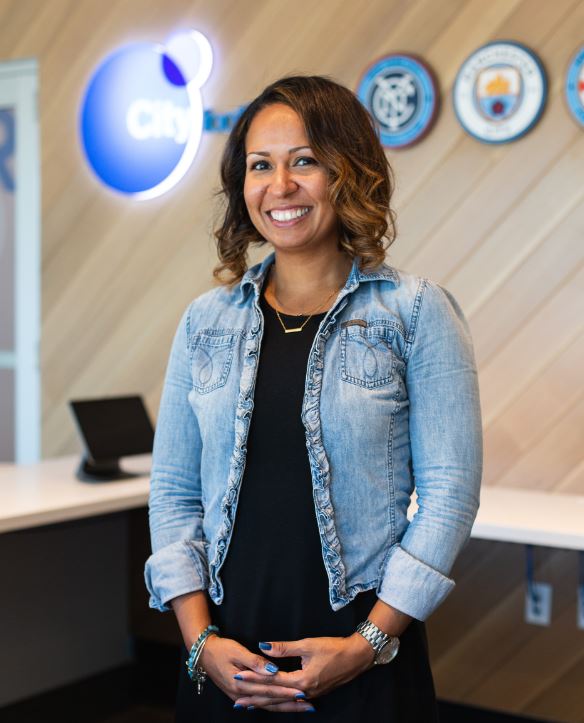
Joyce Jelks,
Head of HR,
New York City FC
As an extension of our #MatchYourAmbition series, we have spoken to a number of key staff members from NYCFC to find how they exert their influence on the Club. In this interview, Joyce Jelks, Head of HR, shares her career story and insights into her role at NYCFC.
Can you talk us through your career journey to date and how you reached your current position?
I have been with NYCFC for one year, before that I was with the New Jersey Devils who are a hockey team and before that I was at the Barclays Center with the Brooklyn Nets (basketball) and New York Islanders (hockey) for 4 years.
Before my career in the sports world, I joined the military aged 17. I started as a Private who was unranked and wanted to become an Officer so joined the Reserve Officers Training Corps, graduated and then went on active duty. I worked in special operations for two years and then moved on to working as an Executive Officer (XO), working for an SES-2, two star General equivalent. He worked in finance for ‘South Com’ which is responsible for all army activity in South America. Before joining the Brooklyn Nets I was based in Washington DC working on a Guantanamo Bay Project.
I am still in the army working as a Major for the South Com reserve group. I am coming up on my 18 year anniversary at the end of 2018.
What initially attracted you to working with NYCFC?
When I first saw the role it was the opportunity to work in a different sport which caught my eye and also the fact that NYCFC was such a new team.
Describe your typical day-to-day role and highlight the elements you enjoy the most.
We are a small HR team so day-to-day we touch all facets of HR which can range from dealing with bench marking and analysis, the organisation structure design and how that will evolve with the new stadium, benefits negotiation, recruiting and retaining staff.
One of my main focuses at the moment is culture building, making it a fun and enjoyable place to work for everyone. I think that having an environment where you enjoy coming to work will enable you to be as productive as possible and we can supply the necessary tools for this to happen.
How do you think your specific role will evolve over the next five years?
I think that for me in particular it will be about becoming more of a magnified business partner who is specialised and knowledgeable in HR. It will be important that I am able to help our president and the wider business with staffing, promotions and progression.
The new stadium project is going to enable all departments to grow and evolve. At the moment, this is bringing me to consider my own career development/progression – do I have the right technical knowledge and skills for when the project begins? I am going to focus on continued learning, exposure, picking people’s brains and taking every opportunity to ensure success.
Retaining our culture during this period of change will also be something we need to focus on. NYCFC is probably one of the best cultures I have experienced outside of the military, everyone is great, means well and we need to ensure we continue to keep that, something which is often hard for businesses to manage as they grow.
Have advances in technology impacted your role in the past few years, and if so, how?
Absolutely. Everywhere I have worked there has been a new HR system, these are constantly evolving and constantly changing. I also think that the way people learn is starting to be more dependent on technology, Gen Z are apparently almost completely dependent on technology so I definitely need to make sure that I up my game and that I am following different trends and understanding how different generations are learning etc.
As far as the club goes, we have a partnership with SAP which is a hugely sophisticated system and in the midst of technology there are also so many different digital platforms. One of my tasks at the moment is how to connect everything. I am working on a curio connection to make sure that if you are making one update, you don’t have to do it 10 different times across different platforms. We need to enable everything to connect together.
What aspects of your role are most challenging and how do you overcome those challenges?
I think learning to deal with different people and personalities can be a challenge. You need to make sure you communicate in a way where your message is received by everyone. People take in information differently, they have different perceptions and experiences so in HR you always have to make sure you staying sound interpersonally, and the care is always there.
I actually finished a book last night, ‘The Team Player’ which talked about being humble, hungry and smart.
In HR you have to continually self-develop so you can help others. If you don’t dig deep and do those tests then you aren’t able to be the best person for your team. For some it isn’t just technical expertise that can be a challenge – it is other elements like these, because those are things that take the most energy to help others.
What have been the most exciting or innovative projects that you have worked on in your current role?
In just a year there have already been so many! The aspects that I really enjoy are the professional development opportunities we can give to employees and the insights/personality discovery which we do with staff. It makes people realise their own values and show them things they don’t know about themselves.
Also developing any opportunities which helps with team dynamics, providing something which gets people interacting and gets them out of the office is honestly I think what I most enjoy.
What are some of the biggest HR initiatives you are currently working on?
There are lots! Right now one of our focuses is getting the right people in for the business and establishing an effective structure. We want to build a pipeline of talent and become a best place to work.
Recently we set up a sales mixer event. We sent an exclusive invite to people we have seen on LinkedIn or have applied for jobs before and they will join us in a suite at a game, meet us, learn about us, and experience the game. This allows us to create unique events that bring in the right people, they get to see the culture, and they buy in to us as a business. Even if they don’t join us in an employee capacity it gives them a good idea of what we are doing and helps us to build our employer recruitment brand.
What is your approach towards recruiting and retaining Millennials? Is the process any different from attracting other generations of talent?
I feel like it is a matter of showing value and being able to make people feel involved. There are more generations who want this, to feel involved, committed and engaged. One other underlying piece which is consistent amongst generations is that people want to know that you care, so show an employee that you do care.
How do you see your current role contributing to the overall success of the business?
You have the business and you have the people, HR links directly to that. If you don’t have the right people, the organisation is not going to thrive. People are the fuel that keeps it going. You can have a business and the business has no identity because they don’t care about their employees.
With that in mind I think ensuring people are motivated, we recruit the right people, making sure we are transparent, communicating, and overall making employees feel good, that will always contribute to success. Our customers will also see that employees are your biggest spokespeople, especially working in sports/entertainment, when an employee is on social media talking about how great an event was. That speaks volumes and people want to be associated with organisations that treat their staff well.
What is the main challenge you think is facing HR over the next five years?
I think it is definitely trying to continue to be relevant and helpful. One thing that may impact HR is sometimes you have HR people who do a lot of heavy admin and processing, which is one element which I think might go away. There are more companies coming in and offering to do this for you, there have been advances in automation, so I think we will move away from things which are more manual to be more streamlined.
Do you think it’s important to continuously upskill, and if so, how do you do it?
Definitely. When I came over from the military and into a civilian role, I wanted to make sure I had the right skills to be successful in my new job. Any certification you can think of, I have done. I have got my Master’s in HR, I recently started a new higher education course in July which runs for 18 months and after that I want to go to Cornell Labour Law School.
I feel like it is important for me personally to further my education so that I feel confident that I have the tools to give people what they need. I feel like if I don’t continue to pursue my education then I shouldn’t be in my role. That is a total personal thing but I feel the most confident the more I further my education.
Is there a piece of advice you could offer to anyone looking to pursue a similar career?
Yes, I have two:
- Continue to learn, take every opportunity you can you learn.
- Be good to people. It’s a small world and it’s so common to cross paths in industries. I believe in good karma, what goes around comes around and I always want to be on the positive side.
What’s the best piece of careers advice you have ever been given?
Pay it forward. I have had some great opportunities, I never thought I would get to here and had no idea that it would be my trajectory but along the way people have helped me/seen something in me. I have always asked what I can do as they have done so much for me and they say you ‘pay it forward’ – you keep helping others.
I have been able to see it with people who have worked for me, people I have mentored, they have gone off to other teams, and they are pursuing other things. It is so rewarding to see my influence and see a positive impact on others.
Do you have any advice for female professionals who are in, or are looking to work in a management or leadership role?
My advice would be to work hard, keep learning and don’t take no for answer. If you feel like you are being limited, then that is probably true, so you have to decide if you want to stay or move on but don’t let someone put a ceiling over what you know you can do. That has happened to me and you need to get out of that situation, move on and progress. Essentially don’t let someone put a cap on the potential you know you have. You only live once!
What’s the greatest risk you took to get where you are today?
Moving from active duty to a civilian career was a pivotal point. I would also say that every time you leave a job or get out of your comfort zone there is a bit of a risk.
What are you most proud of in your career?
The people I have been able to develop. Seeing them get their masters and get further certification makes me really proud.
Also, being able to build diverse teams in the work place. I find that the sports and entertainment industry is a male dominated area and there isn’t a lot of diversity so being able to make a difference here makes me proud.
About the Hays and NYCFC Sponsorship
New York City FC (NYCFC) is an American professional soccer team based in New York City that competes in Major League Soccer (MLS) in the Eastern Conference of the league. Majority owned by City Football Group (CFG), New York City FC plays its home games at Yankee Stadium, and has former US National Team captain Claudio Reyna as its Sporting Director and Domènec Torrent as its Head Coach.
As Official Recruitment Partner, Hays has been pivotal to NYCFC since the Club’s inaugural season in 2015 and has proved instrumental in helping to bring a brand-new soccer franchise to New York City. Together, NYCFC and Hays have developed a truly integrated partnership, with a strong understanding of the synergies between the world of work and elite sport.